One of the most famous legends of Lincolnshire is that of Byard’s Leap — a tale of a fearless horse and a brave knight who fought and won against an evil witch.
The story has endured in part because of its setting, and the supposed evidence that visitors can still see today. Now a lay-by, café, and small cluster of houses beside the busy A17, the site includes the site of the horse’s hoof prints and a sign explaining the legend. Once, so the story goes, a witch lived there — some say in a cave, others in a hut or cottage. She was evil, of course, blighting the land and spreading disease.
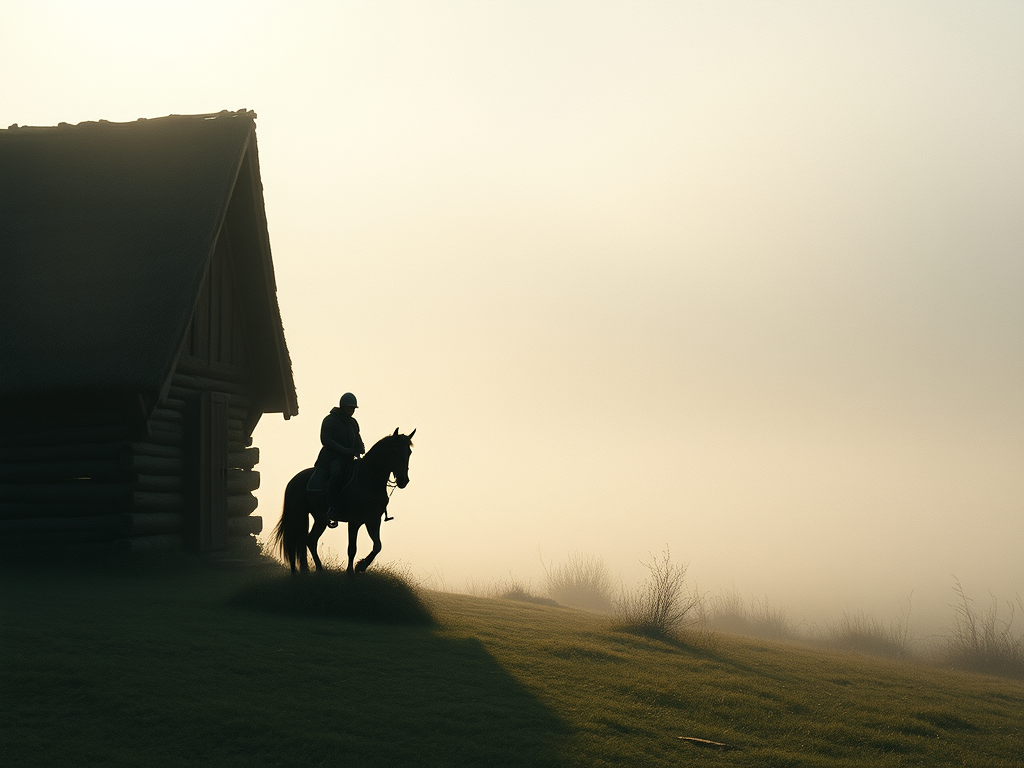
In the nearby town of Ancaster, a soldier or knight returning from war decided to deal with the witch himself. Along with his noble and blind black steed, Byard, he rode to the witch’s dwelling and lured her out. A fight ensued, during which the witch dug her long nails into the horse’s flanks, causing him to leap an impossible distance. The witch was thrown off and killed, freeing the villagers from her curse.
Two sets of hoofprints were once marked in the ground to commemorate Byard’s extraordinary leap, though today only one set remains visible.
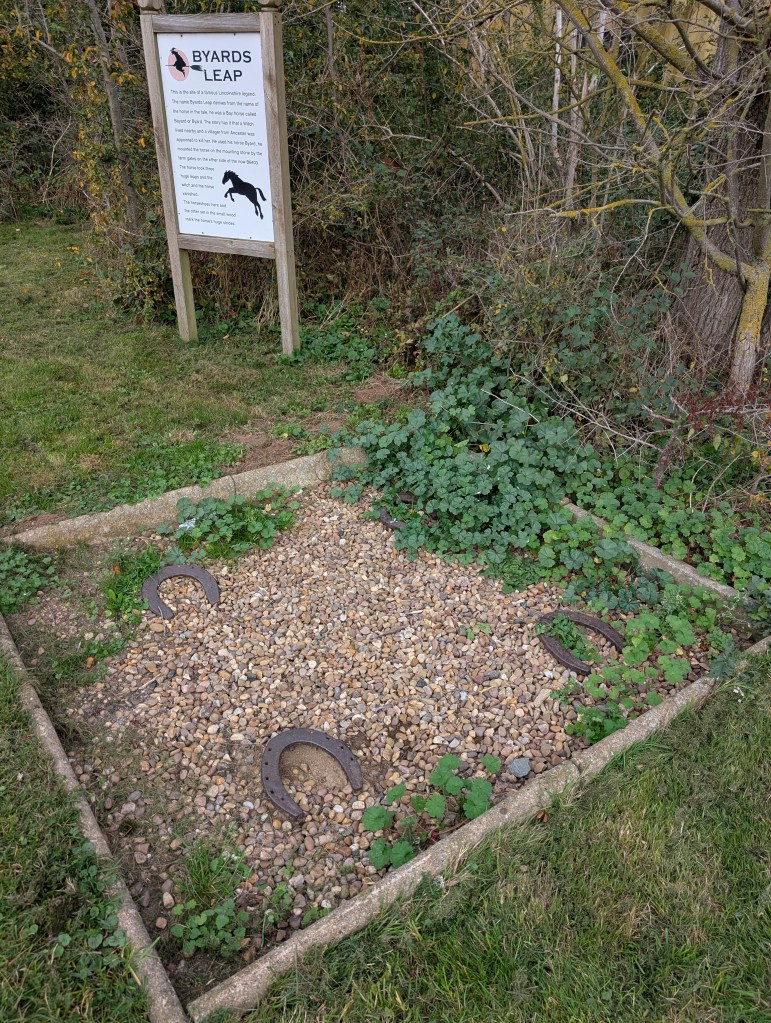
To me, this story feels like a patchwork quilt of the different peoples and time periods that have shaped this land. The area around Byard’s Leap has a deep and varied history. The road beside it — known locally as the Roman Road — was once part of Ermine Street, the great Roman route linking Lincoln and London. When the modern A17 was built, the road’s course shifted slightly, and some of Byard’s hoofprints were moved in the process. But the fact that this was a busy travel route may well be key to the story’s origins.
This part of Lincolnshire lies along the Lincoln Cliff, or Lincoln Edge, an area with unusual geographical features — rocky outcrops and dips that stand out against the county’s famously flat landscape. Even today, the site of Byard’s Leap sits in a shallow alcove, with the A17 running along a higher ridge beside it. The word “leap” often describes a steep embankment or cliff, and such places are frequently associated with tales of impossible jumps.
It seems unlikely that there was ever a cave here. The café now stands on the supposed site of the witch’s home, but there is no sign of rock formations or cliffs that could have contained one — the ridge, in fact, lies clearly on the opposite side. While the area has changed over the years, it is doubtful that an entire cave could have disappeared. More likely, the distinctive dips and hollows made it a natural landmark — a place that drew the imagination of travellers along the ancient road.
One can imagine weary wayfarers on the long trek through Roman Britain, or later centuries, passing the time with stories inspired by what they saw around them.
Adrian Gray, who has written about the folktale, records that the hoofprints were once simply shallow holes in the ground. Later, wooden horseshoes were placed to mark their positions, and these were eventually replaced with the current metal versions. Perhaps the story began when someone noticed natural indentations in the ground that resembled hoofprints. Over time, the landscape’s quirks gave rise to legend.
But what kind of horse could make such a leap — and why? Byard was not just any horse. He appears in other medieval tales as a heroic steed who undertakes great adventures, so his name may have been borrowed for this story as a familiar symbol of courage and loyalty.
Even so, Byard would have needed a reason to jump so far, and that may connect back to the nearby village of Ancaster. In some versions of the story, the knight lives in Ancaster and travels from there to confront the witch. The village lies just three miles from Byard’s Leap — a similar distance to Cranwell — but with a particularly rich history. Once a Roman fort, Ancaster stood on the same major route, and travellers to and from the settlement would have passed Byard’s Leap.
Ancaster also has possible links to ancient goddess worship. It is believed that a temple once stood there, and some scholars suggest the name Ancaster could mean “the Roman fort of Anna.” A spring in the village, known as Lady Well, features in some versions of the Byard’s Leap legend as the pond from which Byard drank before his battle.

These connections to pre-Christian religion may have shaped the story’s evolution. A local goddess could easily have been reimagined as a witch — a figure more recognisable to a medieval audience. Pagan deities were often morally ambiguous, capable of both kindness and cruelty, so the transformation from goddess to witch would have felt natural to storytellers of later centuries.
There is another dark echo in Ancaster’s history. One of the infamous “Belvoir Witches,” Joan Flowers, was reportedly buried beneath a crossroads near the village. In the early 1600s, Flowers — the eldest of three accused women — died on the road between Grantham and Lincoln while being taken to trial, said to have choked on bread during the journey. Though she was never convicted, she was buried at a crossroads — a traditional way to trap a witch’s spirit and prevent it from returning.

It seems likely that this web of associations — pagan worship, witchcraft, and a landscape already heavy with history — provided fertile ground for the story of Byard’s Leap. The legend’s medieval setting fits neatly with the area’s connection to the Knights Templar, who lived at nearby Temple Bruer. The land around Byard’s Leap is thought to have been used by them for jousting or training. In a 1908 account of the legend, folklorists Gutch and Peacock suggested that the marks in the ground could have been remnants of a tiltyard used by knights. Whether or not that’s true, the area’s strong links to chivalry and Christianity made it an ideal backdrop for a tale of a holy knight defeating a dark force.
It’s impossible to say exactly when this tale began, or when the site took on the name Byard’s Leap. Perhaps there was once a wise woman or isolated villager who was accused of witchcraft and met an unjust end. More likely, the story is not rooted in one event at all, but in the collective imagination of generations of travellers.
To me, that makes it all the more fascinating. It pulls together threads of history — Roman roads, pagan gods, medieval knights — and binds them into a single enduring tale. The legend of Byard’s Leap may have started as a story told to pass the time on a long journey, but it has outlived every traveller who ever walked that road.
 Folklore Unfolded
Leave a comment